
Rethinking Detention Tank Sizing with Reuse and Active Drawdown
Rethinking Detention Tank Sizing with Reuse and Active Drawdown
In many stormwater designs, detention tanks are sized under the most conservative assumption: the tank does nothing during the storm. It passively fills, holds peak runoff, and drains later. While safe, this approach can be overly simplistic—and expensive.
When stormwater reuse and drawdown modeling are permitted and explicitly incorporated, reductions of 20–40% in required detention volume are common, even when rainfall and runoff assumptions remain unchanged.
These aren’t hydrologic shortcuts. They’re design strategies based on more accurate timing of inflows, outflows, and inter-event behavior.
Why traditional detention sizing can overestimate volume
Conventional detention models are built around a few fixed assumptions:
- The tank starts full before every storm
- No outflow occurs during the storm
- Reuse systems, if present, aren’t modeled dynamically
- Sediment storage and sump areas are excluded from usable volume
These assumptions create safe, review-friendly designs—but often result in oversized systems. For sites with limited space or tight budgets, that can be a problem.
What stays the same
In this refined approach, the fundamentals don’t change:
- Rainfall intensity and design storm depth are consistent with local requirements
- Total runoff volume is preserved
- Runoff coefficients, impervious coverage, and time of concentration remain the same
What’s changing is how detention volume is timed and allocated—resulting in a more realistic and often more efficient design.
Where the storage savings come from
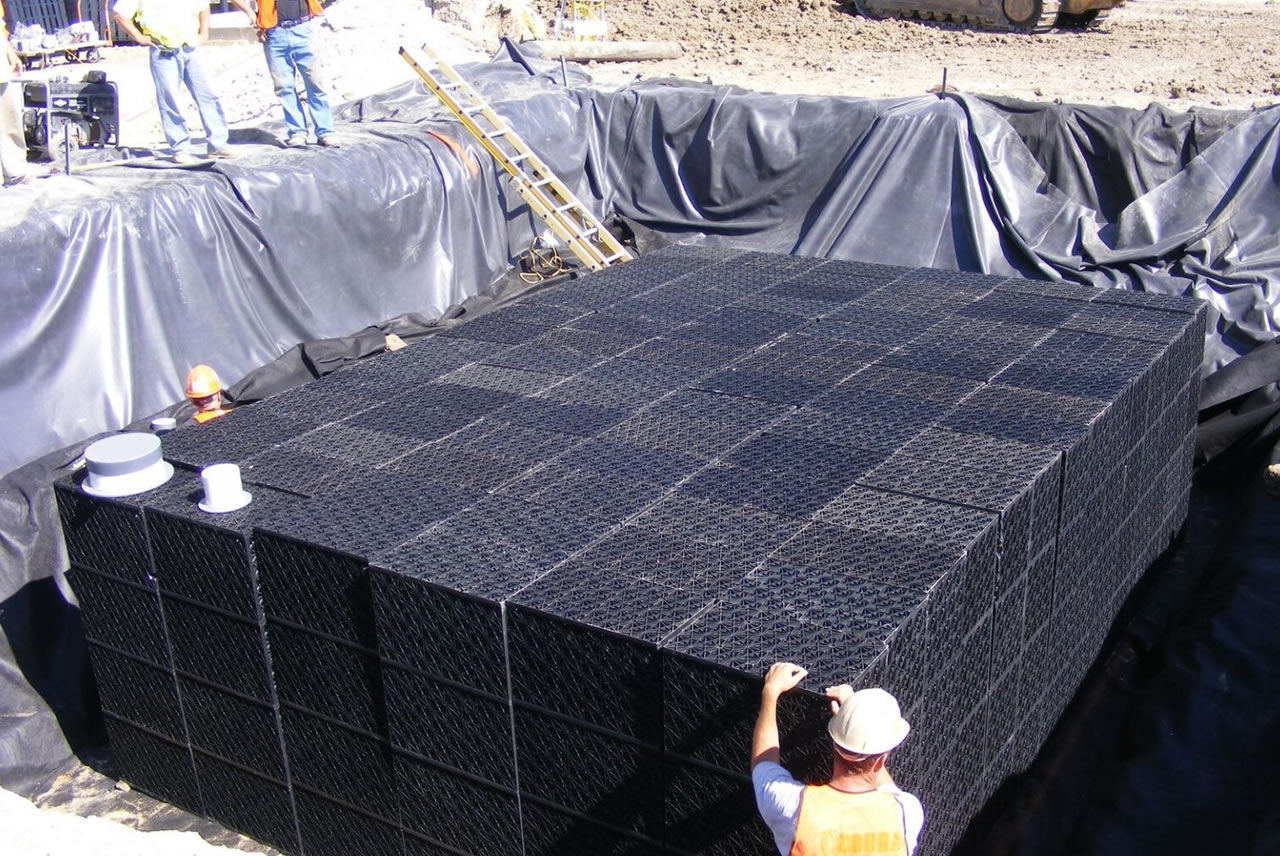
There are three primary opportunities that, when combined, can reduce peak detention volume without compromising compliance:
- Active drawdown during the storm
With a controlled outlet and an operational reuse system, tanks can draw down in real time. This reduces the maximum storage level reached during the storm by allowing inflow and outflow to happen simultaneously. - Reclassifying dead storage as working volume
In some cases, sediment sumps or low zones previously excluded from detention calculations can be partially credited, especially when supported by maintenance schedules and local approval. - Allowing for inter-event drawdown
Instead of assuming a full tank at the start of every storm, modeling actual drain-down behavior between events—via underdrains, reuse demand, or automated controls—can shift the governing storm and reduce required storage.
These strategies aren’t additive, but they stack effectively. When applied together, they reshape the hydrograph in ways that lower peak storage without affecting total discharge volume or downstream capacity.
What this approach doesn’t do
It’s important to clarify what this modeling approach is not intended to accomplish:
- It does not reduce water quality treatment volume
- It does not bypass hydromodification or flow duration control, if required
- It is not applicable in all jurisdictions or for all sites
- It does not reduce total runoff—only the peak storage needed to manage it
But where conditions allow, it can create meaningful design and construction advantages.
When it makes sense to consider
This approach is most beneficial when:
- The site includes—or could include—a non-potable reuse system
- The tank outlet can be actively controlled or throttled
- Available land area or grading constraints limit detention volume
- The reviewing agency accepts time-based modeling of drawdown and reuse
- Cost or constructability favors minimizing excavation or tank footprint
For urban redevelopment and tight infill projects, these advantages can be decisive.
How to evaluate the opportunity
A basic screening can often indicate whether drawdown and reuse strategies are worth pursuing. Key inputs include:
- Project location (city or AHJ)
- Drainage area and impervious percentage
- Reuse type and estimated demand
- Outlet type and downstream capacity constraints
This level of input is often enough to support a preliminary analysis—without the need for full site modeling up front.
Smarter detention, better outcomes
Passive detention remains a valid and widely accepted baseline. But for sites where reuse and controlled drawdown are feasible, it’s time to challenge the default “fill and drain” model. With more accurate hydraulic assumptions, detention systems can often be smaller, more efficient, and better integrated into the overall site layout.
At Wahaso, we’ve developed internal tools that help design teams quickly evaluate the impact of reuse and drawdown on detention sizing. These resources can provide fast insight into whether a project is a good fit for combined reuse/detention systems—especially during early design phases when decisions on tank location and capacity matter most.
Not every site qualifies—but many more do than we used to assume.
Since 2004
Wahaso Mission
Our mission at Wahaso is to help municipalities and commercial property owners reduce the impact of their buildings on the environment through innovative and sustainable water practices.

Call For A Free Estimate
Phone: 800-580-5350
Wahaso
Water Harvesting Solutions
Members of the U.S. Green Building Council (USGBC) www.usgbc.org

View Certifications